
Complete Guide to AI Transformation in Enterprise 2024
Discover the essential steps, strategies, and best practices for successfully implementing AI transformation in your enterprise organization.

Complete Guide to AI Transformation in Enterprise 2024
Executive Summary
AI transformation has officially moved from innovation labs into the boardroom as a critical business imperative. With 92% of enterprises investing in AI but only 1% achieving true AI maturity, the gap between investment and integration represents both the biggest challenge and greatest opportunity for enterprise leaders.
This comprehensive guide provides a strategic framework for navigating successful AI transformation, from initial assessment through enterprise-wide implementation, based on real-world best practices from industry leaders.
92%
of enterprises are investing in AI initiatives
1%
have achieved full AI maturity across operations
34%
of CEOs identify AI as their primary strategic theme
70-85%
of AI projects fail to meet expected outcomes
The Current State of Enterprise AI: From Digital to AI-First Transformation

The language of leadership has fundamentally shifted. According to Gartner's 2024 CEO survey, 87% of CEOs agree that AI's benefits to their business outweigh its risks, representing a dramatic increase in executive confidence compared to previous years.
This shift signals that traditional digital transformation has become table stakes. Cloud adoption, mobile-first experiences, and data analytics are no longer differentiators—they're prerequisites for market participation. AI represents the next frontier where strategic advantage can still be captured.
Why AI Transformation Is Different
Unlike previous enterprise technology adoptions, AI fundamentally changes how businesses create value:
From reactive to predictive: AI enables organizations to anticipate market changes and customer behavior before they occur
From manual to autonomous: Intelligent systems execute complex workflows with minimal human intervention
From generic to personalized: AI allows mass customization at scale
From siloed to integrated: AI breaks down departmental barriers with unified intelligence
Why 99% of Enterprises Remain Stuck in Pilot Purgatory

Despite record investment levels, true AI transformation remains elusive. The reasons for this persistent gap are both technical and organizational:
⚠️ Critical Barriers to AI Success
Data Infrastructure Gaps: Legacy systems create data silos and quality issues that prevent reliable model training
Talent Shortfalls: 57% of organizations cite lack of knowledge as their primary implementation barrier
Shadow AI Proliferation: Teams adopting AI tools independently, bypassing governance
Cultural Resistance: AI perceived as job threat rather than productivity enabler
Leadership Misalignment: Lack of unified vision causes transformation initiatives to fragment
The Five-Phase AI Transformation Roadmap
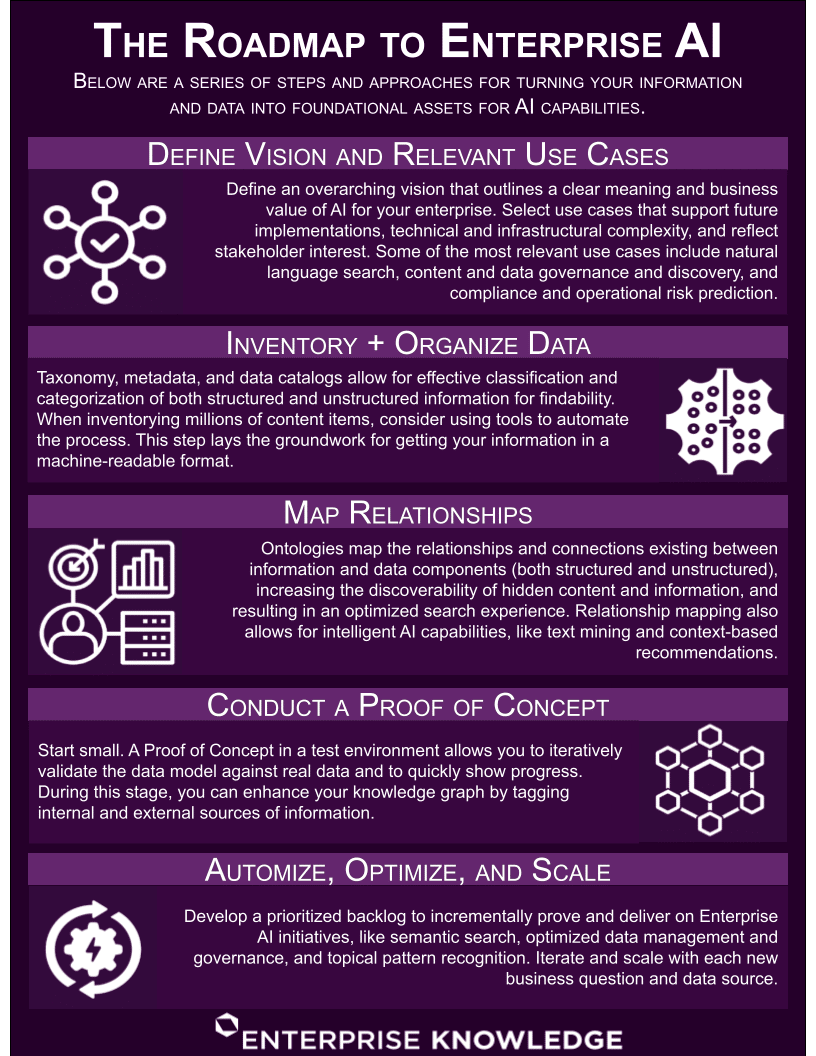
Strategic Implementation Framework
Phase 1: Foundation & Strategy (3-6 months)
Objective: Establish strategic direction and organizational readiness
Executive alignment and sponsorship development
AI vision definition aligned with business strategy
Comprehensive data and infrastructure assessment
Initial governance framework establishment
Phase 2: Data & Infrastructure Preparation (6-12 weeks)
Objective: Build technical foundation for AI at scale
Data audit and quality assessment across systems
Infrastructure evaluation and AI workload planning
Security protocol establishment
Integration architecture design
Phase 3: Pilot Development & Testing (8-16 weeks)
Objective: Validate AI approaches through targeted pilots
High-impact, low-risk use case selection
Pilot development with clear success metrics
Stakeholder engagement and feedback collection
ROI demonstration and scaling preparation
Phase 4: Scaling & Integration (6-18 months)
Objective: Expand successful pilots enterprise-wide
Phased rollout with success criteria gates
Organizational change management
Training programs and knowledge transfer
Performance monitoring and optimization
Phase 5: Optimization & Innovation (Ongoing)
Objective: Continuous improvement and advanced capability development
Real-time performance monitoring
Model retraining and optimization
Advanced AI capability exploration
Innovation pipeline development
Implementation Timeline Benchmarks
Implementation Type | Duration | Key Characteristics | Success Factors |
|---|---|---|---|
Fast Track | 18-24 months | Strong data infrastructure, clear mandate, experienced talent | Executive support, focused use cases, simplified structure |
Standard | 24-30 months | Moderate data maturity, cross-functional coordination | Balanced internal/external expertise, standard change management |
Complex | 30-36+ months | Legacy integration, regulatory requirements, large organization | Comprehensive transformation, significant cultural change |
Six Non-Negotiable Success Factors
Critical Elements for AI Transformation Success
1. Use-Case-Led AI Strategy
Prioritize AI initiatives by business impact and technical feasibility. Example: JPMorgan's DocLLM reduced contract analysis time by 85% through targeted legal workflow deployment.
2. Hybrid Talent Networks
Combine internal capability building with strategic partnerships. Success Story: Airbus trained 10,000+ engineers on AI tools, achieving 40% improvement in simulation cycle times.
3. Agentic AI Systems
Deploy autonomous systems that execute end-to-end workflows. Impact: Unilever's procurement agents deliver $250M annually through continuous optimization.
4. Responsible AI Governance
Establish frameworks for ethical, transparent operations. Example: CVS Health uses AWS Guardrails for FDA-compliant pharmacy AI systems.
5. Data-Centric Architecture
Treat data as strategic asset requiring active management. Success: Mayo Clinic's Medical-GPT achieved superior performance through curated medical datasets.
6. Continuous Feedback Loops
Enable systematic improvement and adaptation. Implementation: Qualtrics integrates customer feedback directly into AI workflows for real-time optimization.
AI ROI Framework and Financial Planning
Investment Breakdown
Technology Infrastructure (30-40%): Cloud resources, AI platforms, integration tools
Talent & Training (25-35%): Specialist hiring, upskilling programs, change management
Data Transformation (20-30%): Quality improvement, process redesign, governance
Project Management (10-15%): Program resources, consulting, validation
Expected ROI Timeline
6-12 Months
Short-term: 15-25% efficiency gains, 10-20% cost reductions
12-24 Months
Medium-term: 5-15% revenue increase, 10-30% satisfaction improvement
24+ Months
Long-term: Business transformation, 3-5x innovation acceleration
Industry Benchmark: High-performing organizations achieve 5:1 returns on AI investments, compared to an average of 3:1 across all organizations.
Common Pitfalls and Prevention Strategies
🚨 Top Implementation Pitfalls
Pitfall 1: Unrealistic Timeline Expectations
Problem: 42% of businesses scrapped AI initiatives due to aggressive timelines
Solution: Set expectations based on maturity, break into 3-4 month phases
Pitfall 2: Technology-First Thinking
Problem: Starting with AI capabilities rather than business problems
Solution: Always begin with clearly defined business challenges
Pitfall 3: Underestimating Data Preparation
Problem: Consistently underestimating time for data quality improvement
Solution: Allocate 40-60% of project time to data preparation
Evolved C-Suite: New Roles in AI Leadership
🎯 Redefined Executive Responsibilities
CEO: Champion AI as competitive operating model, establish governance
CIO/CDO: Architect data backbone, ensure security and compliance
CFO: Transform AI from cost center to revenue enabler
CHRO: Lead workforce transformation and cultural change
CTO: Evaluate platforms, ensure scalability, drive innovation
Measuring AI Transformation Success

Five Critical Measurement Areas
Operational Efficiency: Reduction in manual hours, error rates, cycle times
Time-to-Market: Faster development cycles, quicker market response
Customer Experience: Improved NPS, resolution times, satisfaction
Revenue Impact: Direct attribution, conversion rates, new streams
Employee Productivity: Strategic work reallocation, output increases
Your AI Transformation Action Plan
The competitive imperative is clear: Organizations that successfully bridge the gap between AI investment and operational integration will capture outsized market advantages.
Next Steps:
Assess your AI maturity level using established frameworks
Identify 3 high-impact, low-risk pilot opportunities
Conduct comprehensive data audit to understand preparation needs
Build cross-functional AI team with clear accountability
Establish governance framework early to prevent costly rework
Create phased implementation plan with specific milestones
Remember: Successful AI transformation isn't about moving fast—it's about moving strategically with disciplined execution and unwavering focus on business value.
About This Guide
This comprehensive guide synthesizes insights from industry leaders, research from McKinsey, Gartner, and Deloitte, and real-world case studies from successful AI transformations at companies like JPMorgan, Airbus, Unilever, and CVS Health.
Sources: Promethium AI, Ideas2IT, Enterprise Strategies, McKinsey, Gartner